
 Image 1 of 2
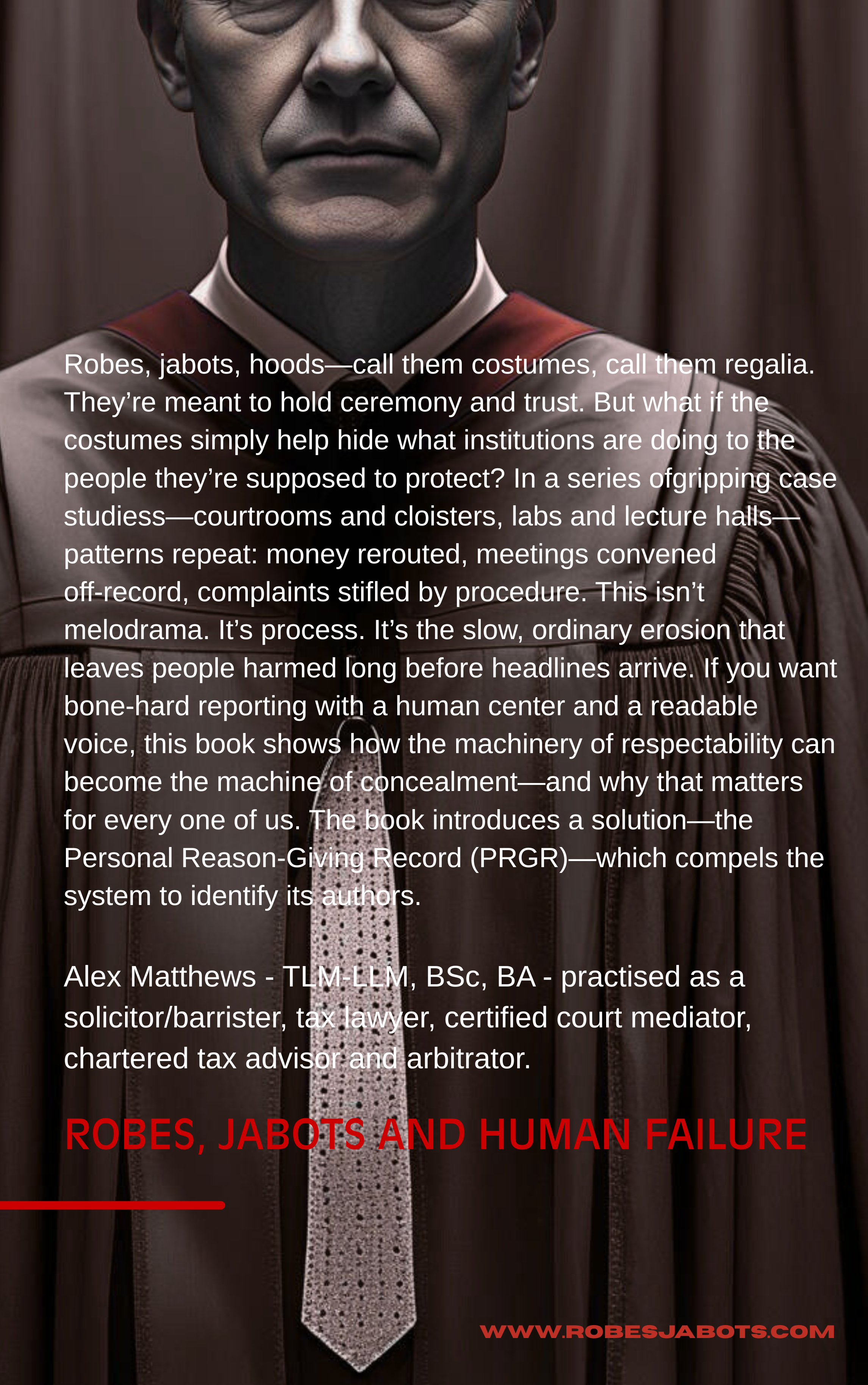 Image 2 of 2
Non-Fiction | Politics & Social Sciences | Institutional Critique & Policy Blueprint
The Robe and the Ledger is for anyone who has ever felt ground down by a system they were told to trust. It speaks directly to whistleblowers, advocates, and survivors of institutional harm—but also to the people inside the machine: lawyers, academics, clergy, administrators, and managers who may not realize how easily “doing the process” becomes doing damage.
Through a series of gripping, meticulously researched composite case studies spanning courts, churches, and universities, the book exposes a repeating pattern: when harm occurs, institutions often respond with prestige and paperwork, not responsibility. The language stays polished. The rituals remain intact. And accountability dissolves into committees, delays, and “insufficient information.”
A tool for change: PRGR
At the heart of the book is the PRGR (Personal Reason-Giving Record)—a simple, scalable accountability system built on one radical principle:
Every harm must have a named author.
PRGR is not a theory or a slogan. It’s a practical technology for responsibility—designed to make the invisible mechanics of power visible, traceable, and reformable. In a world full of books that identify what’s broken, The Robe and the Ledger offers a concrete method for forcing institutions to own what they do.
Non-Fiction | Politics & Social Sciences | Institutional Critique & Policy Blueprint
The Robe and the Ledger is for anyone who has ever felt ground down by a system they were told to trust. It speaks directly to whistleblowers, advocates, and survivors of institutional harm—but also to the people inside the machine: lawyers, academics, clergy, administrators, and managers who may not realize how easily “doing the process” becomes doing damage.
Through a series of gripping, meticulously researched composite case studies spanning courts, churches, and universities, the book exposes a repeating pattern: when harm occurs, institutions often respond with prestige and paperwork, not responsibility. The language stays polished. The rituals remain intact. And accountability dissolves into committees, delays, and “insufficient information.”
A tool for change: PRGR
At the heart of the book is the PRGR (Personal Reason-Giving Record)—a simple, scalable accountability system built on one radical principle:
Every harm must have a named author.
PRGR is not a theory or a slogan. It’s a practical technology for responsibility—designed to make the invisible mechanics of power visible, traceable, and reformable. In a world full of books that identify what’s broken, The Robe and the Ledger offers a concrete method for forcing institutions to own what they do.